
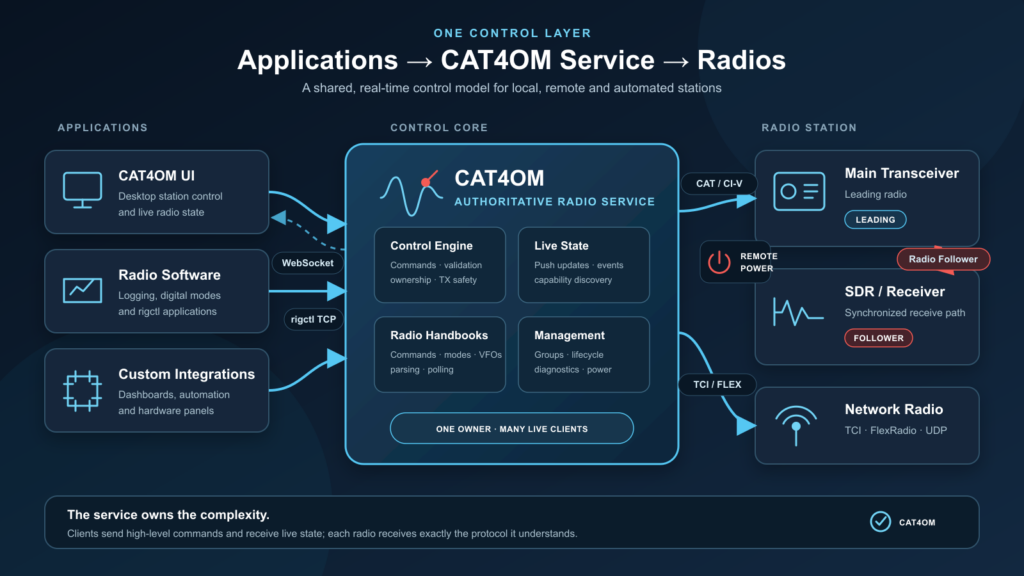
CAT4OM uses a service-based real-time architecture with Management and Control endpoints, live state updates, ownership, structured WebSocket messages, and audio-capable protocol paths.
A service-based control architecture
CAT4OM separates radio communication from user interfaces and external applications. The central service talks to the radios, validates commands, manages state, and distributes updates. Clients can focus on presentation, monitoring, integration, or automation.
This architecture gives the station a stable control layer instead of making every application implement radio-specific behavior independently.
Real-time state distribution
Connected clients receive live state updates from the service. Frequency, mode, VFO, split, PTT, ownership, connection status, metering, and other state values can be distributed as they change.
This enables:
- responsive desktop control;
- monitoring dashboards;
- logging and digital-mode integrations;
- follower-radio synchronization;
- status pages;
- custom automation;
- diagnostic tools.
One model across different radios
CAT4OM normalizes different radio protocols into a shared control model. Serial CAT, CI-V, TCI, FlexRadio SmartSDR, and other connection styles can all be represented through common station concepts.
The common model includes:
- radios and groups;
- connection status;
- frequency and mode;
- VFOs;
- split;
- PTT;
- RIT/XIT;
- metering;
- available commands;
- client ownership;
- events and state updates.
Management and Control endpoints
CAT4OM exposes separate Management and Control paths.
Management operations cover station structure and lifecycle: service status, group discovery, group start/stop, radio start/stop, configuration read/write, handbook discovery, connection tests, log-level control, radio power operations, audio device discovery, and audio level monitoring.
Control operations cover live radio behavior: reading state, requesting ownership, setting frequency and mode, setting PTT, selecting VFOs, controlling split, setting RIT/XIT, using tuner operations, sending CW, running diagnostics, sending raw CAT commands, reconnecting radios, and using audio streaming where supported.
Separating Management and Control helps keep responsibilities clear. A monitoring tool may need Management access but not live transmit control. A digital-mode integration may need Control access to one group but not configuration rights for the whole station.
Native protocol characteristics
The native CAT4OM protocol uses structured request and response messages over WebSocket connections. It includes a simple hello/welcome handshake, protocol versioning, correlation IDs, state-update pushes, event pushes, feature announcements, authentication metadata, keepalive behavior, structured errors, and binary audio streaming frames.
For integration authors, this is more predictable than parsing a radio’s raw CAT stream directly. A client can request state, understand ownership, inspect available commands, react to updates, and handle errors through a documented station-level protocol.
Audio-capable real-time paths
CAT4OM’s architecture also covers audio-capable profiles. Supported setups can use TCI RX/TX audio routing, and the native CAT4OM protocol includes binary audio frames for CAT4OM-aware clients.
Audio features can include per-radio device selection, separate RX and TX devices, sample-rate negotiation, receive level monitoring, TX audio pacing, native RX listening controls, TX audio path control, and microphone-on-PTT behavior where supported.
Real-time does not mean uncontrolled
CAT4OM is designed for live operation, but live operation still needs rules. State updates are pushed in real time, while write operations remain tied to ownership and capability checks.
That combination is central to the architecture: fast enough for responsive UI and integrations, but structured enough that the station remains understandable when several clients are connected.
Use CAT4OM as the real-time control layer between radios, operator UI, logging tools, digital-mode clients, and custom station software.